Private Label Porcelain Tiles From India for European Distributors – How to Start Your Own Tile Brand Using Indian Manufacturer
June 9, 2026
How European Tile Distributors Are Building Their Own Brands With Private Label Manufacturing from India
You picked up a tile box at a trade fair last year. Italian brand on the front. “Made in Morbi, India” on the back. You paid around EUR 14 per sqm at the factory gate. Your customer paid EUR 38 on the shelf.
That gap is exactly why this conversation is happening.
Distributors across Germany, the Netherlands, Belgium, the UK, and Poland have been watching this for years. The same tile leaving the same factory in Gujarat ends up in three different showrooms under three different brand names, all competing on price. The one with the thinnest margin loses. That’s usually the distributor in the middle.
Private labels change that. The factory produces. You brand. Your customer sees a collection that exists only in your showroom, under your name, at the price point you set.
Why European Distributors Are Moving Away From Reselling Branded Collections
The margin gap is the first reason, and it’s real. When you source through a brand owner, you’re paying for two layers of margin before the tiles even reach you. The manufacturer earns theirs. The brand owner earns theirs. Your ceiling is already decided for you.
Distributors who switch to private label porcelain tile manufacturers India regularly report approximately 20 to 40 percent better margins versus reselling equivalent branded collections. That comes from removing the brand licence cost and buying at manufacturing cost. Indian manufacturers who export regularly to Europe carry current EN 14411 test documentation as standard, so the compliance baseline is already built into a serious export partnership.
The second reason is the showroom problem. If the same collection sits at three distributors in your city, every sales conversation ends with a customer checking prices on their phone. Private labels remove that entirely. Your collection only exists under your brand. Nobody else carries it.
The third is brand equity. Every catalogue, every contractor referral builds equity in something. Right now, if you’re reselling someone else’s range, all that effort benefits their brand. Belgium is seeing some of the strongest private label interest right now, given how competitive the Benelux multi-brand showroom market has become. If you’re based there, the timing makes sense.
White Label, Private Label, and Custom Manufacturing: What's Actually Different
These three get used interchangeably. They’re not the same.
Why Each Certification Matters, and What North American Buyers Need to Know
Buyers assume the supplier has the right certifications, don’t ask to see the actual documents, and only find out there’s a problem when a shipment gets held at port or rejected from a project spec. If you’re importing into Europe or North America, compliance documentation isn’t optional.
For European buyers, three certifications matter most:
ISO 9001 covers quality management systems. A supplier with active ISO 9001 has had their production processes and quality control independently audited. You’re working with a supplier who operates systematically, not reactively.
CE Marking is mandatory for products entering the European Economic Area. Without it, your tiles can face complications in EU commercial project specs or retail distribution.
EN 14411 is the European standard for ceramic tiles, covering water absorption, breaking strength, surface abrasion resistance, and dimensional tolerances. Architects and procurement managers in Germany, the Netherlands, the UK, ask for this by default.
White label, private label, custom manufacturing. Three sourcing models. Three different levels of brand ownership. Most European distributors launching a house brand start in the middle.
White Label: You take a standard factory product and put your name on it. Fast and cheap to start, but anyone else can carry the same tile with a different sticker.
Private Label: This is where most serious European distributors land. A 600x1200mm matte concrete-effect floor tile leaves the Morbi factory in a carton with your logo, your SKU, your brand name in Dutch or German. Your customer opens it and sees your brand. The tile comes from an existing factory collection. The branding is entirely yours. For white label tiles India Europe buyers building a house brand, this is the starting point that makes commercial sense. For how the same model works for a different market, read our guide on private label tile manufacturing for US brands.
Custom Manufacturing: Custom tile manufacturing in Morbi is where fully custom specifications come in. You’re defining the product itself: exclusive designs, finishes, or sizes that don’t exist in the standard catalogue. Higher lead times, higher investment, but the product is genuinely unique at every level. Most European distributors start with private label and move toward custom manufacturing as their range matures.
What Wolf Actually Offers for European Private Label
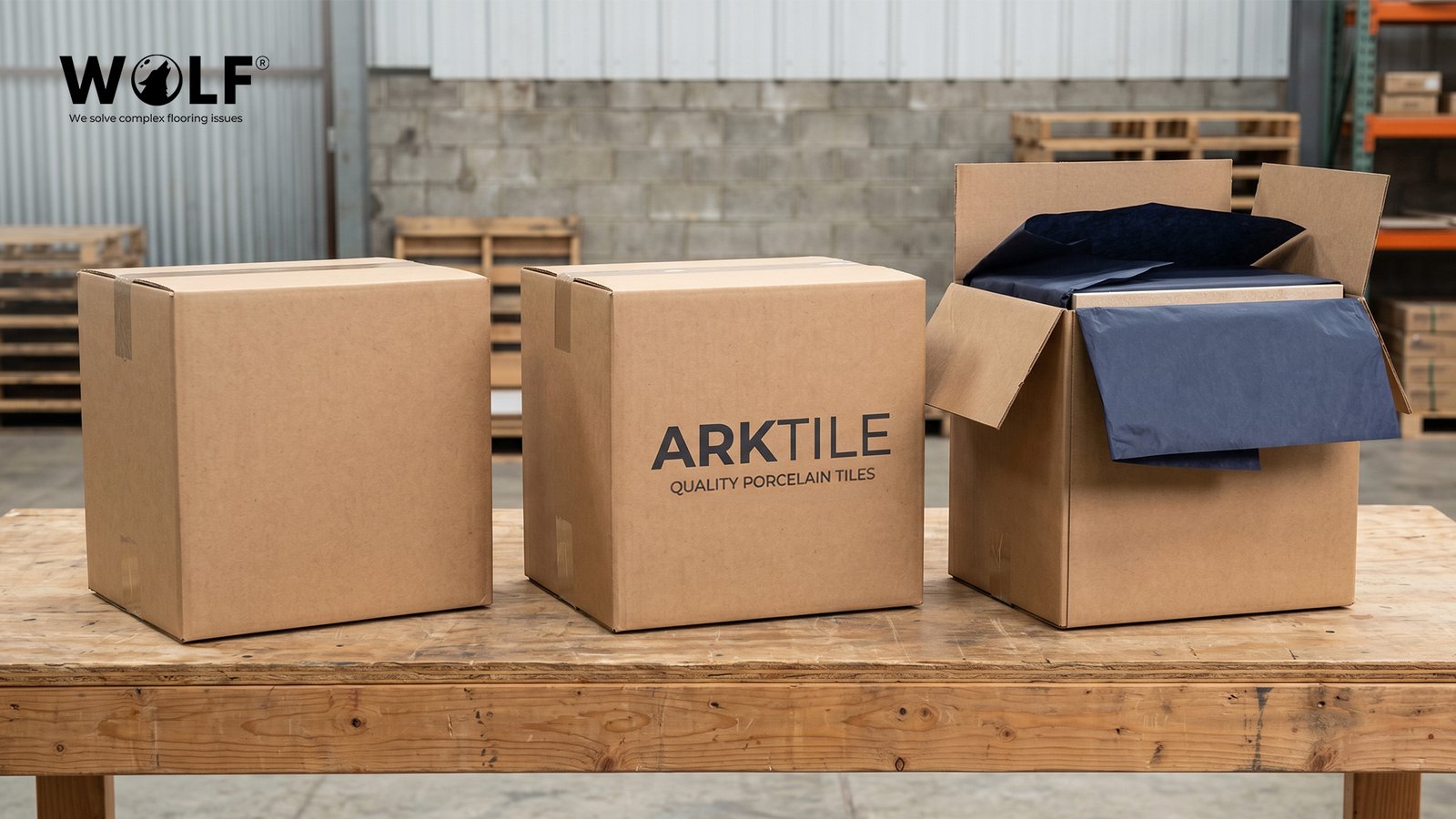
Custom packaging is the foundation. From the moment a carton comes off the pallet at your warehouse, it should look like your product: custom carton design, logo printing, labelling in your required language, barcode integration, and pallet marking that fits your incoming goods process.
Product selection comes from existing factory collections. A distributor building a high-margin floor tile programme might select from the 600x1200mm porcelain collection as the core format. The tooling is done. You brand it and control how it’s priced in your market.
Export documentation is handled by people who do this regularly. Technical datasheets, test reports, packing lists, customs paperwork. It shouldn’t be something you’re chasing after the shipment has left.
MOQ is structured around container-load quantities. A practical entry point before you’ve tested the collection. Volumes grow as the range grows.
Interested in private labelling? Request sample packaging mockups and pricing.
What it doesn’t cover is CE compliance when you’re the private label brand owner. That’s a different set of responsibilities.
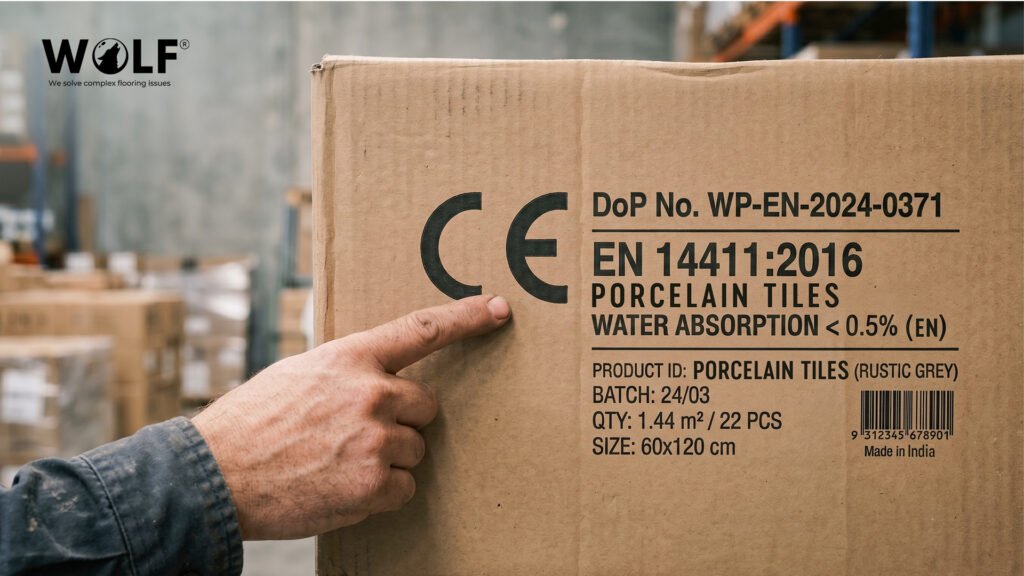
Under the EU Construction Products Regulation, someone has to be the Responsible Person for a CE-marked product placed on the EU market. When you import tiles under your own brand name, that person is you. The factory provides test reports, EN 14411 classification, and technical files. But the Declaration of Performance and CE marking on the packaging are your obligation as brand owner and importer.
This surprises a lot of first-time private label buyers. The factory doesn’t CE-mark your product for you. They give you the documentation to do it correctly. You apply it under your brand.
The CE mark and DoP reference number on this carton are the importer's responsibility, not the factory's. When you brief the packaging artwork, these must already be in the spec.
Practically: when briefing the factory on your packaging artwork, the CE marking block and DoP reference number must be in that brief. Leave it out and you’ll be reprinting cartons.
UK buyers: post-Brexit, CE marking is not enough. The UK requires UKCA marking through a separate conformity assessment route. Plan for this from the start.
Working with anISO certified tile exporter means test reports are current and the documentation process is already understood. For CE compliant private label tiles India buyers, documentation quality matters as much as product quality.
The Economics of Private Label: What the Numbers Actually Look Like
These are indicative ranges based on typical export market pricing discussions. Actual costs vary by format, finish, and volume.
A distributor buying a branded 600x1200mm matte porcelain tile for Germany or the Netherlands through a brand distributor pays around EUR 16 to EUR 22 per sqm wholesale, retailing at EUR 35 to EUR 45. That margin already includes the brand owner’s cut.
Source the same tile directly as custom branded tiles India from Morbi at manufacturing cost? Factory gate pricing typically runs EUR 8 to EUR 12 per sqm. Landed in Germany or the Netherlands after freight and duties: EUR 14 to EUR 18 per sqm. Against the same EUR 35 to EUR 45 retail price, the margin difference is real.
No SKU matching from competitors. No parallel distribution pressure. Stronger repeat purchases because customers associate the product with your business.
How a container is loaded and how efficiently space is used affects your landed cost per sqm significantly. Thecontainer loading guide is worth reviewing before your first volume order.
How to Start Your Private Label Journey With Wolf
From first contact to delivered shipment, the process typically runs 10 to 16 weeks. It’s structured, not complicated.
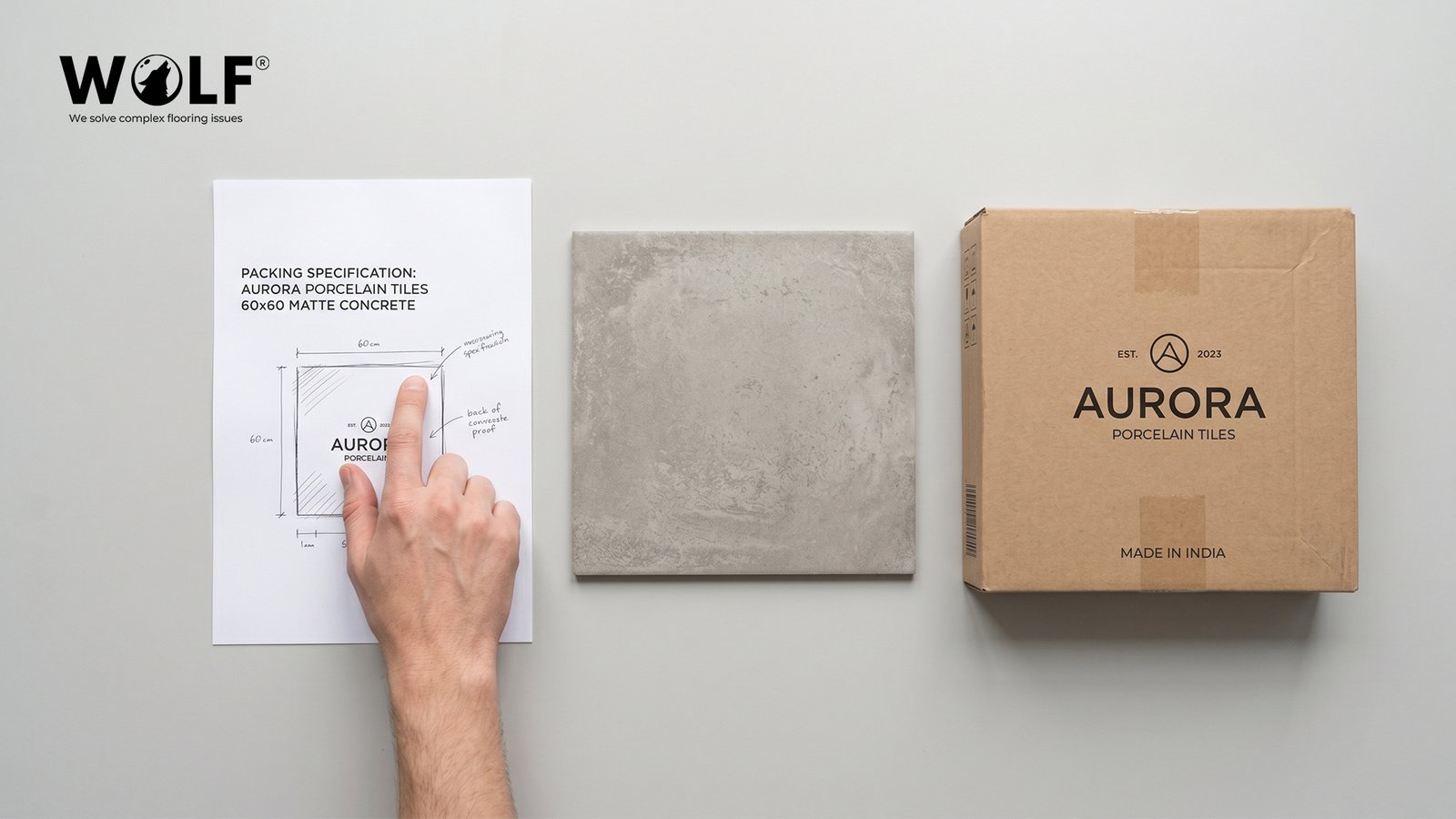
A spec sheet, a tile sample, and a branded carton. These three things need to be right before production starts. Getting all three aligned is what the private label process is built around.
Step 1: Define your range. Two or three SKUs to start is smarter than a full catalogue.
Step 2: Share branding requirements. Logo files, label language, barcode format, packaging specs. The factory builds the artwork from here.
Step 3: Review samples and packaging mockups. Product quality and branding both need sign-off before production.
Step 4: Confirm compliance documentation. Test reports, EN 14411 classification, and your DoP obligations as importer of record, before production starts.
Step 5: Approve and start production.
Step 6: Products ship under your brand. What arrives is your collection, with your name on every box.
Everything about ourprivate label tile manufacturing process is built around European distributor requirements, from documentation to packaging to container planning.
A factory in India produces the tiles and you sell them under your own brand name. You control the branding, pricing, and positioning. The factory handles production.
As the importer and brand owner, you are the Responsible Person under EU CPR. The manufacturer provides documentation. CE marking on packaging is your obligation.